Favorite Movies: The Sound of Music
SPOILER ALERT: This film came out in 1965, but I will attempt to forego overt spoilers. If, by some miracle, you have not seen the film, the musical it was based on, or read about its plot, I highly encourage you to go engage with it yourself. Then come back here and let’s chat about it.
The light wasn’t the first thing I remembered. The first thing I remembered was the sound.
When I was a child, my older brother and I would often spend the weekend at my grandmother’s house. We would sleep on the pullout couch in the front parlor. The couch had that scratchy, plaid fabric. But when it pulled out into a bed, it became a soft place to rest for the night. Often, my cousin, Janelle, would be there too. We were all together, and the connective tissue was the sound of my grandmother singing.
Grandma Charles would wake us up with singing. “Let the sun shine in…” she would sing as she opened the blinds. Then, as if in a momentary fulfilling of her prophecy, the sun would, indeed, shine in. Things were right back then. Everything seemed to fall into place.
The parlor opened to the dining room, where a large table was the field of play for many family dinners. Next to the table was a piano, where Grandma would play at night to put us to sleep. Walk through the dining room and you would find yourself in the kitchen. There, after waking us up with her morning singing routine, Grandma would make poached eggs for us for breakfast. I always loved breaking up the bread for her.
Those are the memories that the sound of music brings to me.
As for The Sound of Music - that legendary 1965 Best Picture winner? It also brings my Grandma Charles to mind. In that same parlor where we would sleep on the pullout couch sat a television that looked more like a piece of furniture than our modern, sleek gadgets. On that television we would often watch the film that brought a 1959 Rodgers & Hammerstein musical to an even bigger audience. I recently watched this film for the first time in years. It was as if not a day had passed.
Be warned - this movie has no explosions. Its heavily-veiled depictions of sexuality come in subtle hints, not overt displays more common to today’s storytelling. There are no depictions of violence - well, one to a Nazi flag. In fact, that short clip may be the one most recognizable to today’s audiences, as it has become a fairly common GIF.
This is a movie musical about a singing family in Austria. No, that log line wouldn’t jump off the page to most audiences today. And yet…
…watch this film again and you will find it to be so present - so vital - to our current moment.
The film is driven by the powerhouse lead performance from Dame Julie Andrews as Maria. When the film was released, she was fresh off a Best Actress win for Mary Poppins. That’s what you call being on a roll.
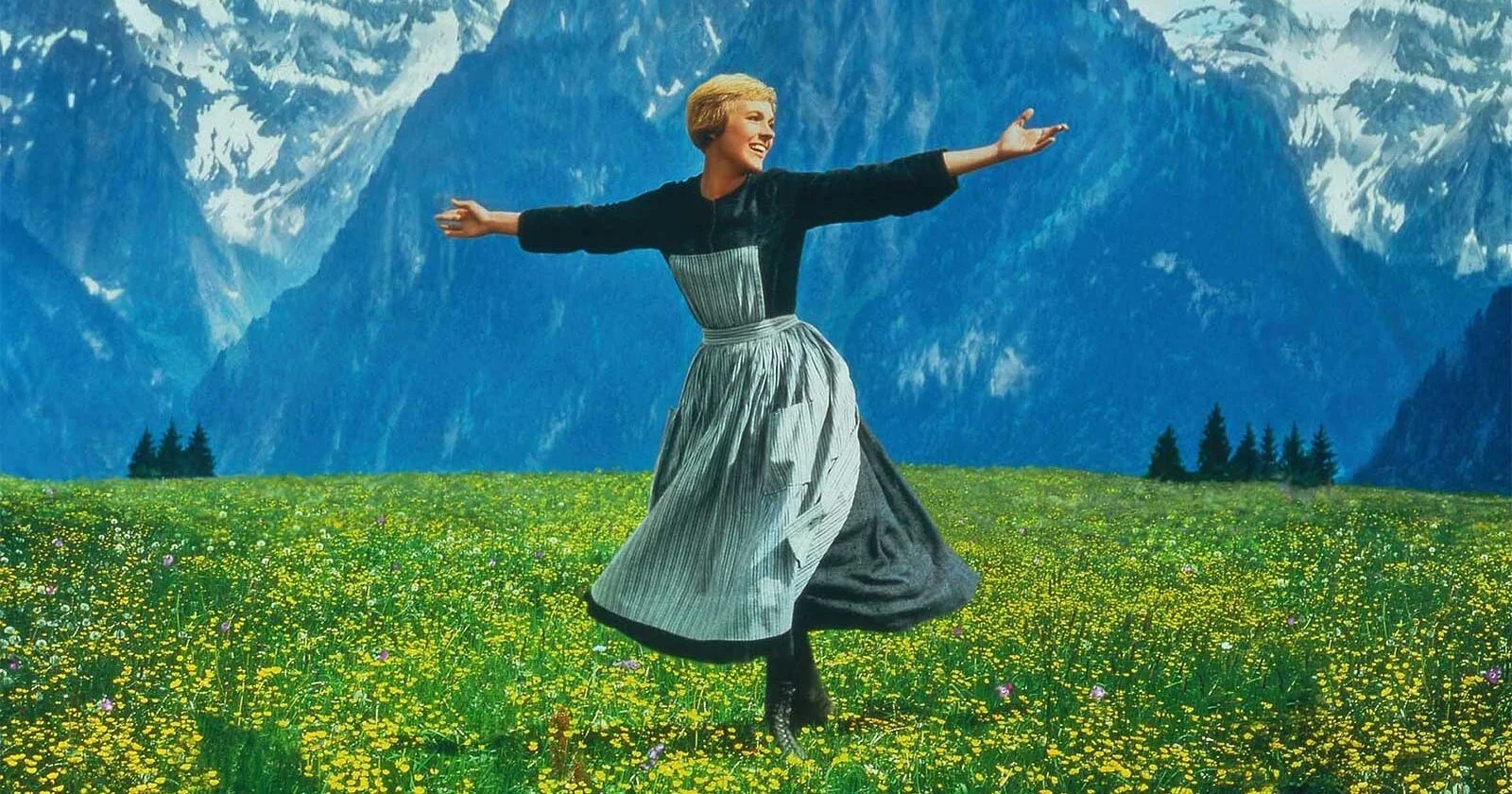
In the iconic opening scene, Maria sings the titular tune amid the Austrian Alps near Salzburg. The hills are alive, indeed! She is studying to become a nun at a nearby abbey. We soon learn that she may not have all the time to be frolicking and singing amid the flowers as it seems. She is routinely late, which leads the other nuns to sing about the various ways to solve a problem like Maria.
At this point, even if you’ve never seen the film, you may begin to recognize the source of songs that you have heard from time to time. To say the film’s music has been embedded in culture is to woefully understate the truth. These are some of the most beloved songs in both Broadway and movie history.
The film is adapted from the 1959 musical of the same name by Richard Rodgers and Oscar Hammerstein II. Both are legends in their own right (Rodgers was the first person to ever complete the coveted EGOT). Robert Wise directed the film for the big screen. His credentials stand up with the other icons behind this film - he had already won the Oscar for Best Director in the Best Picture-winning musical West Side Story in 1961. Twenty years before that, he served as the editor for Citizen Kane - what many call the greatest film ever made.
The way to solve a problem like Maria? Have her take a job as a governess with an Austrian family of…checks notes…seven children! Captain Georg von Trapp (Christopher Plummer) is a widowed naval officer. He expects his children to be educated and well-behaved. There is Liesl (Charmian Carr), Friedrich (Nicholas Hammond), Louisa (Heather Menzies), Kurt (Duane Chase), Brigitta (Angela Cartwright), Marta (Debbie Turner), and Greta (Kym Karath). Captain von Trapp soon finds that Maria’s inability to follow the rules of the abbey carry over to the rules he wishes to militarily instill in his household.
While the household is incomplete, that may soon be changing. You see, Captain von Trapp’s friend, Max Detweiler (Richard Hadyn) is on his way to the family’s palatial home with Elsa (Eleanor Parker), a baroness engaged to Captain von Trapp. Max is an enterprising music producer who is looking for the next star to feature in his upcoming music festival and make him great amounts of money. The Baroness is simply looking to marry well.
Romantic scenes ensue. There is a love interest for the eldest von Trapp child, Liesl, that brings about another iconic song. (All the songs are iconic, okay? I’ll save some words and just get that out of the way.) But those storylines meet their conclusion well before the end of the film. There is a greater tension here than simply which characters will end up together.
This film is set in Austria in the 1930s. What is only hinted at in the early scenes of the film becomes clear as the plot unfolds - the Nazi Anschluss is underway.
This, of course, was the annexation of Austria by the Nazis in 1938. As with any non-documentary film in a historical setting, there are creative licenses taken. Yet, that horror from the pages of history gives this film its grounding in truth.
Before I continue, let me state plainly that my saying this film is supremely present to our current moment has nothing to do with comparing anyone or any political group to Nazis. That comparison has become tiresome in current conversations, and it is just plain wrong. The Nazis were a unique evil. I don’t see that same evil present in our current situation.
However, it is a rather low bar to simply not be a Nazi. One of the themes I find compelling in this film is that we can call for people to be more than just “not a Nazi”, though we should certainly call for them to be that.
Take, for instance, an interaction between Captain von Trapp and Max early in the film.
“MAX: What’s going to happen is going to happen. Just make sure it doesn’t happen to you.
CAPTAIN VON TRAPP: Max, don’t you ever say that again!
MAX: You know I have no political convictions. Can I help it if other people do?
CAPTAIN VON TRAPP: Oh yes, you can help it!”
To make the point clear, the “what’s going to happen” that Max is referring to is the continued advance of the Nazis. Though the film never details them, we know the atrocities that this advance brought about.
Many have said it is a mortal flaw that the film doesn’t go into more detail. They say it is a sanitized version of history - that you can’t put a musical sheen on the horrors of 1930s Europe. That is undoubtedly true, and yet I think the film has other designs. Look at that interaction again.
Captain von Trapp is not content to simply let his friend be a watchful bystander of what is occurring. The movie makes clear that Max is not a Nazi himself. Yet, as a wealthy member of society, Max is also willing to let them do as they please - so long as he continues to get paid. It is that last line of the interaction quoted above that I find so powerful.
Captain von Trapp is not willing to let his friend off the hook for not having political convictions himself. He calls him to push back against the immoral political convictions of those around him.
We are seeing hate rise up in ways that are frightening and that demand action. Europe is seeing far-right parties grow in influence despite their acceptance of the trappings of Nazism. It is fair to point out that our very own leaders in America have called for Europe to accept those parties. That rhetoric should be repudiated with the harshest tone possible, even if those putting it forth are not Nazis themselves - as I have clearly stated.
Yet, while there may not be many Nazis on our current political spectrum, I think we are awash with people like Max. People who are more concerned about money than what is right. People that are only concerned about what impacts them. If others are going through pain and injustice, it is not their concern. That may not constitute being a Nazi, but it does constitute being immoral.
We cannot settle for letting our fellow countrymen say they are not as bad as the worst movement the world has seen. Like Captain von Trapp, we can ask them to be even better than that.
It is here that I find a connection to another iconic piece of art - one that maybe hasn’t ever been mentioned in a review of The Sound of Music before.
“You will not be able to stay home, brother
You will not be able to plug in, turn on and cop out
You will not be able to lose yourself on skag
And skip out for beer during commercials, because
The revolution will not be televised”
My artistic tastes tend towards grittier dramas that plumb the depths of truth and human experience. Most wouldn’t put The Sound of Music anywhere near that camp. They probably would put The Revolution Will Not Be Televised by Gil Scott-Heron in such a camp. On the surface, the two may not seem like obvious companions. However, in both of them, I find a call to get up, take notice, and do something.
By invoking both here, I want to try to get at something. Some fans of both works of art might even be offended that I would compare one with the other. If you find yourself feeling that way because of some of the words Scott-Heron uses or the classic musical’s lack to go far enough, bear with me a moment longer.
“Climb ev’ry mountain
Search high and low
Follow ev’ry by-way
Every path you know”
“Maria, these walls were not built to shut out problems. You have to face them.”
Both of those quotes come from the Mother Abess (Peggy Wood). The first is sung in the film’s closing. The second is said directly to Maria, in an earlier scene where she is unsure if she should pursue a relationship with Captain von Trapp. That tension is small potatoes compared to the problems they will face later in the film. It is saccharine compared to the problems that Gil Scott-Heron deals with in his monumental poem. Yet its basic truth connects despite all that.
We cannot shy away from the problems that face us.
No, the problems we face may be different than the problems others do. Ours may not be as bad. But we must face them. Once we do - hearkening back to the interaction quoted earlier between Max and Captain von Trapp - we cannot be content to let the problems of others fail to move us.
We must do what we can to face those, too.
My Grandma Charles was born in 1923. She grew up during the Great Depression and World War II. After the war, she went to Europe with other Anabaptists to help rebuild the war torn countries. She and my Grandpa Charles worked as superintendents of a children’s home in Illinois, in the town where my father was born. By the time I was watching The Sound of Music in her front parlor, Grandma had made a life by caring for and teaching children - including the seven that she called her own.
If that sounds a bit like Maria von Trapp - well, I guess there are similarities. My grandmother was not a revolutionary in the way we often think of that term. But she loved with a revolutionary love. That may sound schmaltzy. Maybe it is. Yet, I know it to be true. When we watched this film together, I never thought about the fact that my Grandma lived through this time. She saw areas that were decimated by hate. She did what she could to make things better.
The Sound of Music reached a level of acclaim that few films before or after have achieved. It was the highest-grossing film of 1965 and it became the highest-grossing film of all time one year later, when it surpassed Gone with the Wind (it would hold that distinction for five years). It won awards from all the major critics organizations - including five Oscars (Best Picture, Best Director, Best Film Editing, Best Scoring, and Best Sound).
I feel that it continues to earn those lofty plaudits because it calls us to timeless truths about the best of ourselves. Some problems cannot be shut out by the physical walls of church buildings. We want to be safe. We want to be insulated from pain and suffering. But that is not the way this world works.
Instead, we must climb mountains. We must unplug, turn off, and opt in. It might feel naive to say doing such things will help us find our dream. But the dream of being free at last from hate is a dream worth our lives.
It is a dream that will need all the love we can give, every day of our life, for as long as we live.
NOTE ON CONTENT: This film is rated G, with some intense scenes toward the end of the film and a few instances of smoking and - extremely light - innuendo. It is a film that is appropriate for the entire family. It is a film that is vital for the entire family.